

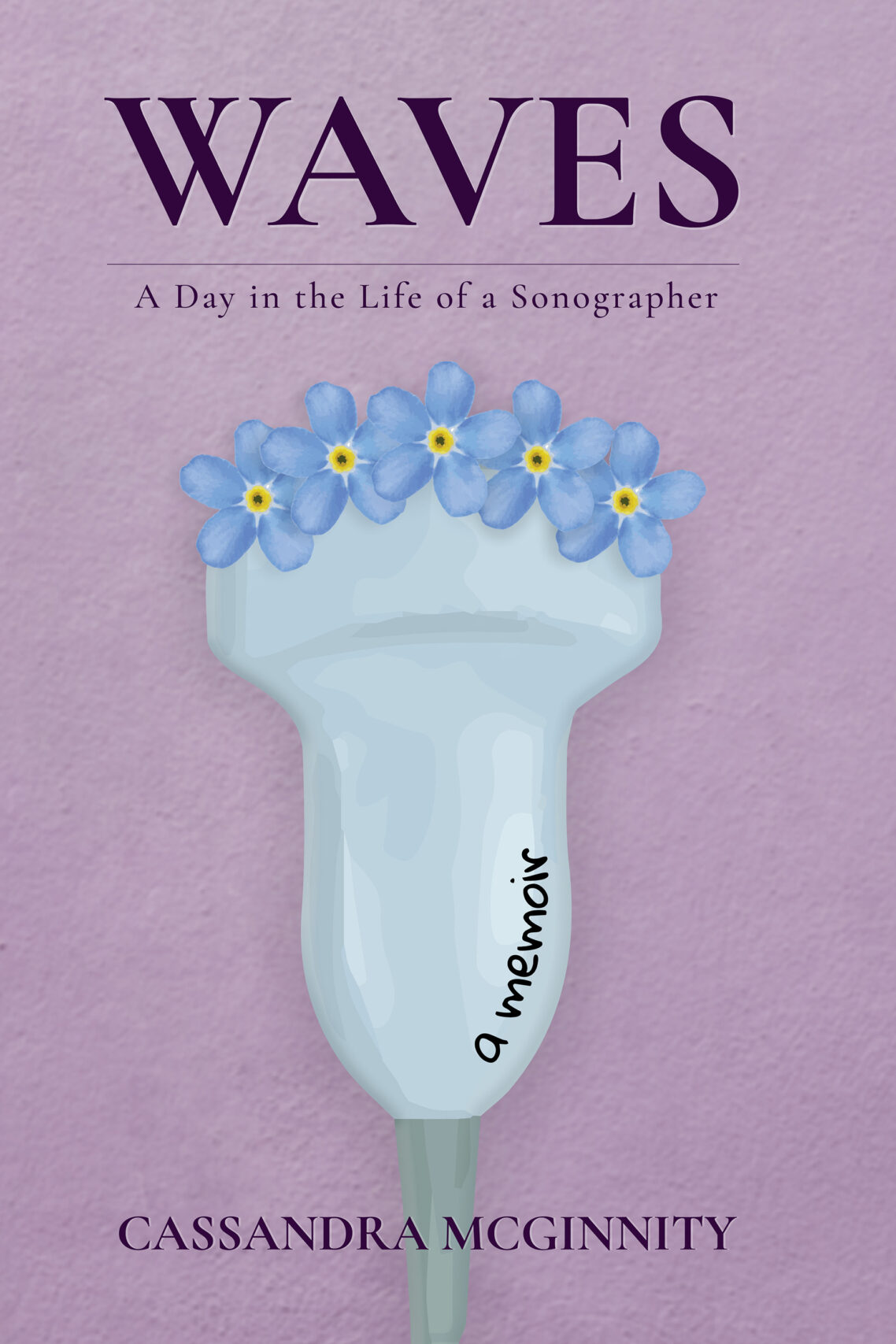
When I finished reading Waves: A Day in the Life of a Sonographer, Cassandra McGinnity’s harrowing tale of a day in her life as a high-risk sonographer, I was left deeply grateful that an obscure healthcare worker, laboring in the darkest of rooms in nondescript medical facilities, was able to shed light, with the precision of a perfectly executed sonograph, about what ails the healthcare system in the United States today. By the time she starts her day at 7:08 a.m., we already know that Cassie is a wounded veteran of the profession, enduring constant shoulder pain and other physical challenges that are collateral damage of an industry that is utterly indifferent to its expendable grunt workers.
The cases she sees all day are heart-wrenching. What’s a pregnant woman to do if her fetus appears bottom down (known as a breech), not head down, as is necessary for a vaginal birth? A c-section is the only way out. A woman shows up with her partner and parents, only to find out that her baby can’t survive outside the womb. Imagine the bombshell that falls in that dark room when Cassie marshals the words to break the news. “That’s the thing they don’t tell you in this job,” says the author. “At some point, you will not just be a sonographer, but also a therapist, a provider, a nurse, a social worker, a genetic counselor, a picture taker, a scheduler, an interpreter, and possibly the only support that a patient has in these moments.” Pregnant addicts have their own set of problems, and women, like Chelsea, have no recourse to medical magic to get their baby breathing and moving again. It is Cassie again who has to announce the baby’s death.
The fleeting lunch break for the ten-year veteran brings no relief before she finds herself walking back to the waiting room to call the name of her next patient, whose ultrasound reveals twin pregnancies (two separate babies inhabiting the same womb). This is probably the only time in Cassie’s day that she doesn’t have to be the apostle of gloom. A scan of her next patient (forty-one-year-old Mary) reveals no anomalies in the twenty-eight-week pregnancy, but shows that the mother has a lymphoma. “The middle-aged woman could be at the end of her life,” Cassie writes, but “she is carrying the beginning of life within her.”
Working in a high-risk prenatal hospital is not, Cassie admits, for the “faint of heart,” but how much stress can one healthcare worker handle in a single day? By 2:02 p.m., she is spotting “intrauterine growth restriction” in Susan, meaning that the fetus is too small for a thirty-two-week pregnancy. Then you have women who go through extreme measures and sacrifices, including in vitro fertilization (IVF), without any rewards. “A lot of women who go through IVF do not end up with a child. All that money, effort, shots, ultrasounds, and bloodwork, and not much to show for it other than some bruises and an empty bank account.” There is Lauren, too, who is thirty-seven weeks pregnant with a fetus measuring five weeks behind. The best option is to send her for immediate delivery to give the baby a living chance.
By the time her day is done, Cassie races out of the hospital to catch up with her husband and daughter, leaving behind a trail of tears. Scarred and tired, she eventually gives up on her full-time job for part-time work in an infertility clinic. Like an infantry soldier who has survived a brutal war, it is clear that Cassie’s view of the ravages of the medical-industrial complex will forever shape the way she sees the world. But she amply deserves her part of glory. She did her best to save lives, and she lived to tell us the untold history of pregnancy and birth. Waves must be read by everyone who cares about life in a hyper-medicalized society and the joys and terrors of biological needs.


Comments are moderated by the editor and may not appear on this discussion until they have been reviewed and deemed appropriate for posting. All information collected is handled in a manner consistent with our privacy policy.