
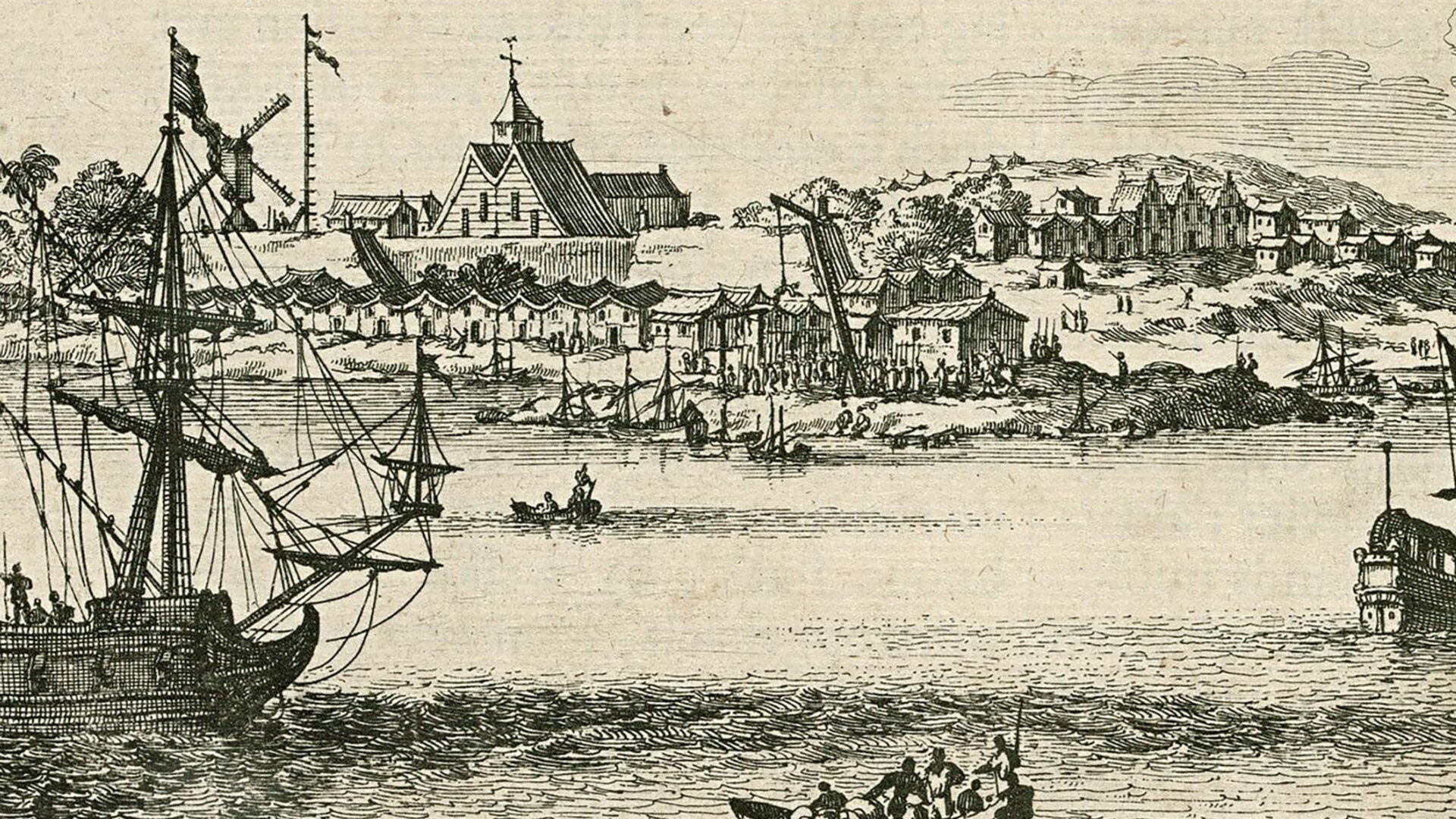
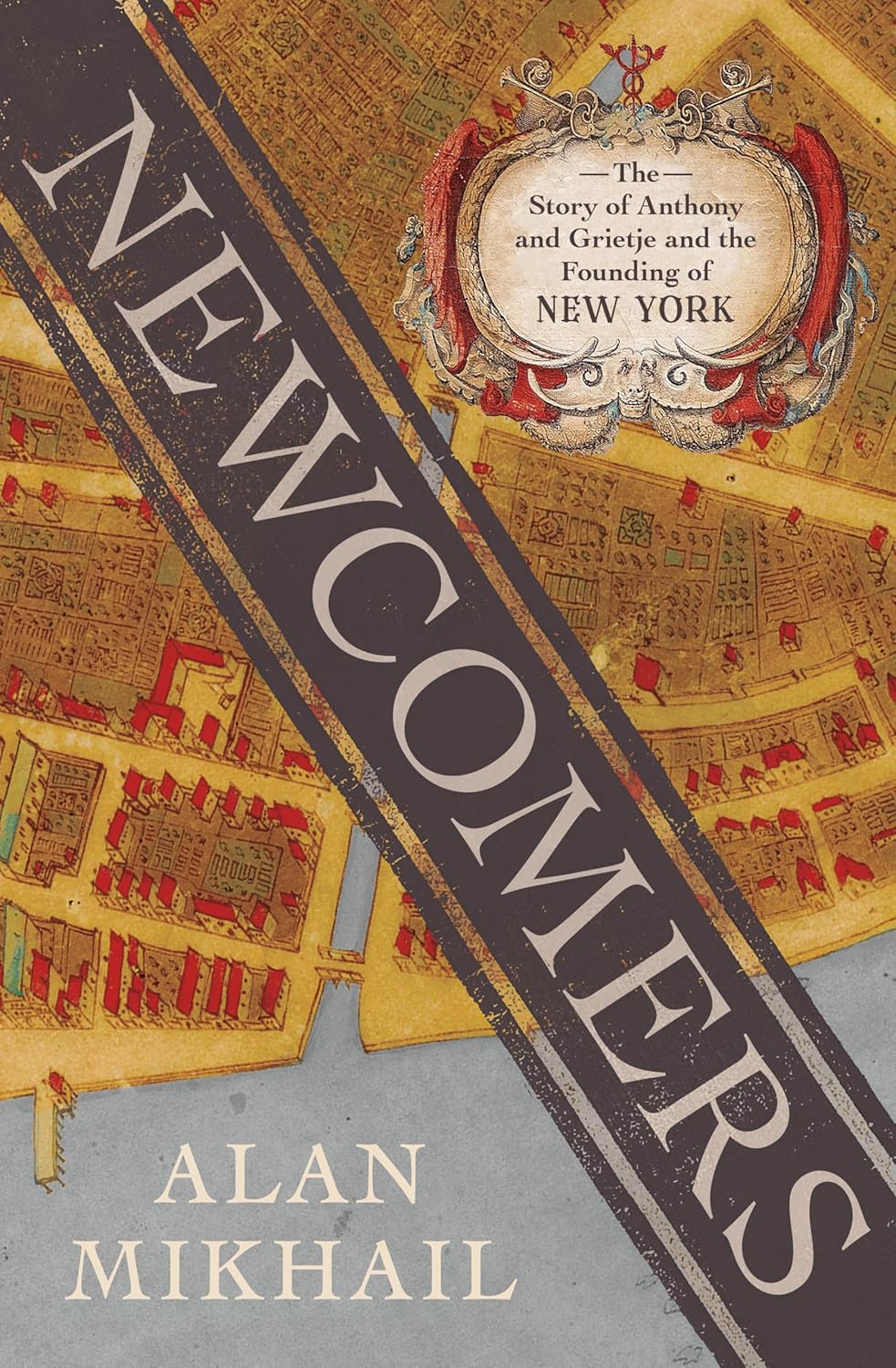
If you Google Anthony Jansen van Salee, you’d find dozens of articles claiming him as Moroccan, one of the earliest Muslims to settle in America, and one of the founders of New York. Such claims are understandable, the historian Alan Mikhail tells us in his latest book, Newcomers: The Story of Anthony and Grietje and the Founding of New York, because Muslim-Americans, like any other minority, want to be part of the origin story of the United States, to prove to themselves and others that they, too, have a right to the powerful nation they call their home.
According to the 2017 “Muslims in Brooklyn” project of the Brooklyn Historical Society, Anthony was the “first person of Muslim descent” to purchase land in Brooklyn. Unlike the well-known case of African Muslims who arrived in America in chains, Anthony disembarked as a free man who managed to own land and establish himself as a solid (albeit rehabilitated) member of the Dutch community in what was then New Netherland, the Dutch colony on the Atlantic coast of North America. Not only do Muslims who claim his ancestry conveniently avoid the troubling legacy of Dutch dispossession of Native people (the wilden, or “wild ones,” as they were called) and enslavement of Africans, but they are also most certainly wrong on the facts. “As it turns out,” Mikhail writes, “Anthony was not the son of the Dutch convert to Islam Jan Jansen. In fact, no action in his life ever evidenced an adherence to Islam. The only religion he ever manifested was Christianity.”
Why, then, did Anthony Jansen turn into the “Turk,” a “Mauhammetan,” and even a “horned beast” for the Dutch when he never associated himself with Islam or Muslims? This is what Newcomers attemtps to elucidate. What Mikhail does in his superb scholarly work is situate Anthony in a broad historical context to help readers make sense of his enigmatic life. It is indeed puzzling as to why the Dutch, upon Anthony’s arrival in the New World, start disparaging him with anti-Muslim tropes. We are led to assume that there was something about him (perhaps his and his wife’s relentlessly contentious natures) that provoked such contempt.
Given the fact that he appeared from nowhere in Amsterdam and that he was not Dutch, we could agree that there might be a grain of truth about his religious and racial origins. One common explanation is that he was the son of Jan Jansen van Haarlem, the Dutch sea captain who converted to Islam, changed his name to Murat Reis, and joined the band of feared Moroccan corsairs known as the “Salee Rovers” who wanted to exact revenge on the Christians who expelled them from Spain in the fifteenth century.
The scholarly consensus on Anthony’s Muslim identity has been unambiguous. In 1851, a historian and politician by the name of Tunis Bergen published an article making the case that Anthony was born in Morocco to Jan Jansen and set the ground for similar refrains of the same hypothesis. Yet, according to Anthony’s 1629 marriage certificate (the first record we have of Anthony anywhere in the world), the twenty-two-year-old sailor was from Cartagena (most likely the Spanish city, even though there is another Cartagena in South America). His marriage to the older Grietje, a German emigrant reputed to be a whore and troublemaker on the docks of Amsterdam, a woman who had already buried a child born out of wedlock, is not a profile a Muslim would typically choose for a wife. Moreover, the couple was married at the Dutch Reformed Church, an affiliation Anthony would keep for the rest of his life. Given the information in the marriage certificate, Anthony couldn’t be Jan Jansen’s son.
Surveying the global scene of the period, Mikhail thinks that one plausible explanation was guilt through mere contact. “If Anthony was a captive in North Africa,” Mikhail writes, “then it means that he was very likely Christian, or by some measure perceived to be at the time of his capture. From North Africa, or at the very least from captivity on a North African ship, there are some tentative glimpses suggesting the specific routes that might have delivered someone like Anthony to Amsterdam.” In this way, a Catholic sailor from Cartagena was indelibly stamped with the stain of Islam. This is all it took for him to be branded for life. As a captive, Anthony could have worked for the renegade Murat Reis (formerly Jan Jansen), who, I might imagine, could have inspired the young man to seek refuge in his native country.
With no prospects in Amsterdam, the sailor and his wife Grietje opted to try their luck in America, where they quickly established themselves as subsistence farmers on what is now Broad Street in lower Manhattan. Ironically, it is in the new Dutch outpost, an ocean away from Amsterdam, that he is regularly defamed as “a Turk, a rascal and horned beast,” while his wife is branded as a prostitute. With such credentials, the vilified couple stood outside the moral norms of the community that was dispossessing the Natives of the land and enslaving Africans. Eventually, they were banished from New Amsterdam to a parcel of land on what is today Long Island.
The couple would soon be joined by another outcast from the Puritan Massachusetts Bay Colony, the English Anabaptist Lady Deborah Moody, who established Gravesend. As Anthony built a family, he turned out to be a reliable agent for New Netherland, threatened as it was by incursions from Natives and later the British. He grew into a member of the elite, hiring farmhands from Europe. By the 1650s, the couple, enriched by four daughters, achieved the American dream under Dutch auspices. Eventually, after their children married, they sold their farm and moved to nearby Gravesend.
As British incursions on New Netherland grew more intense, the Dutch surrendered in 1664, and the aging couple found themselves under the banner of the Duke of York, King Charles’ younger brother. Five years later, Grietje died. Losing his wife of forty years, Anthony moved to Bridge Street in Manhattan, which was now part of New York, and married a younger Dutch woman from an elite background. The Dutch managed to recapture the city, but they lost it again—this time for good—in 1674. Two years later, he appears in British court records as Anthony “Johnson,” his name undergoing yet another identity shift and adding to the elusiveness that has bedeviled his historians and genealogists. He died that same year, leaving behind a legacy that would establish him and his wife as genuine founders of New York City.
Although Newcomers is most likely to endure as the most accomplished scholarly work on Anthony van Salee, it will also most definitely impress readers with its edifying literary style and perfectly curated prose. When Anthony and Grietje met in Amesterdam as “newcomers to the city, one from upriver, the other down ocean, neither with obvious marriage prospects or intentions, they lived close to where they first landed in Amterdam, never that far from the docks, always within sight of ships’ masts over the coast’s rooftops.” But when they arrive in New Netherland, or Lenapehoking, as the Native Lenape called it, “brothels and beer gave way to forests and deer.” When the couple was banished from New Amsterdam, Mikhail reached out for the metaphor of Adam and Eve, who were expelled from paradise. “If all of us are descendants of Adam and Eve,” Mikhail writes, “then Anthony and Grietje might be said to represent the historical and spiritual postlapsarian parents of ‘other’ Americans not yet captured by the dominant narratives of race, belonging, and colonization.” The story of Anthony continues to intrigue us because a “non-Dutch man rumored to be Muslim, and a servant and barmaid from Germany were the real shapers of New Netherland, its longest residents, and thus the true founders of New York.”
This is what is ultimately striking about Newcomers—it speaks to all new Americans who fall outside the nation’s main genealogical narrative. An Egyptian-American Christian born and raised in the United States, and a distinguished professor of history at Yale University, Alan Mikhail is well-equipped to see through the conflicting claims of identity, perhaps feeling a bond of camaraderie with a brave man who, according to the available historical record, erased his beginnings to survive and seek a life of accomplishment and dignity in America. The condition for making ourselves anew—to echo the language of American independence—is relinquishing habits and memories that complicate assimilation and encumber ambition. It’s a Faustian bargain that is only resolved over the generations, when the descendants of a pioneer such as Anthony proudly proclaim their ancestor as a founder of their nation. But to a man without the pedigree of a Puritan, no education and no known history, America was simply the land of new beginnings.

Comments are moderated by the editor and may not appear on this discussion until they have been reviewed and deemed appropriate for posting. All information collected is handled in a manner consistent with our privacy policy.